Why OpenAI’s Agent Kit Isn’t the n8n Killer Everyone Expected

OpenAI dropped their Agent Kit today with considerable fanfare, promising developers an easier path to building AI-powered agents. The announcement video showcased slick demos of conversational agents that could handle tasks, integrate with tools, and respond intelligently to user queries. On the surface, it looks impressive. But for anyone who’s been building production-grade AI workflows, the announcement was a bit lackluster, raising a critical question: Why would you lock yourself into OpenAI’s walled garden when n8n already does this—and so much more?
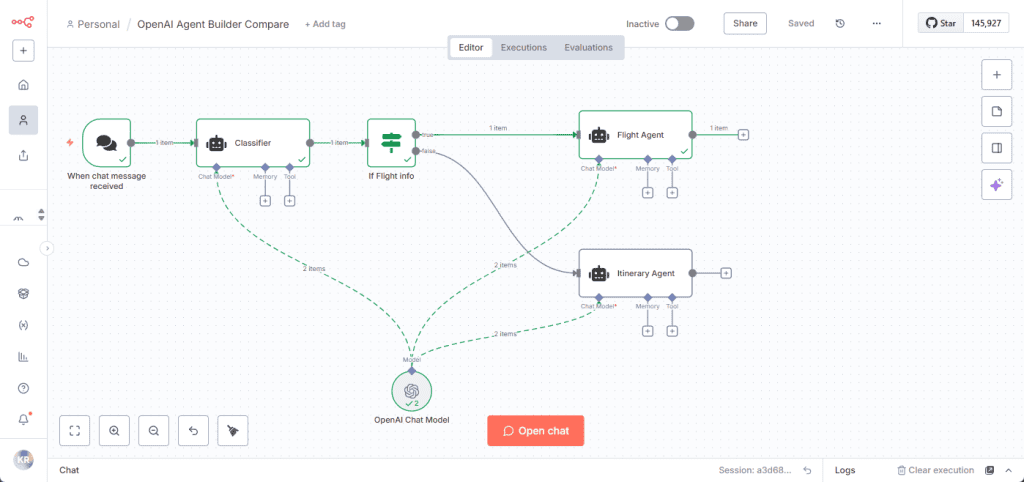
Tonight, after I built a head-to-head comparison workflow in n8n in just a few minutes (which you can download and run yourself for free – link below). The answer became crystal clear: OpenAI’s Agent Kit is a specialized tool for a narrow use case, while n8n is a comprehensive automation platform that excels in AI orchestration. If you’re serious about building scalable, flexible, and cost-effective AI workflows, n8n isn’t just competitive with Agent Kit—it’s in a completely different league.
What OpenAI Agent Kit Actually Offers
To be fair, OpenAI’s Agent Kit does solve a real problem. It provides a structured framework for building conversational AI agents that can call functions, maintain context, and interact with external tools. The Python and TypeScript SDKs are pretty cool and make it relatively straightforward for developers to define agent behaviors, specify tools, and deploy chat-based interfaces.
The pitch is simple: if you’re already invested in the OpenAI ecosystem and need to quickly spin up a GPT-4-powered chatbot with some custom functions, Agent Kit gives you the scaffolding to do that. The new Agent Builder interface even offers a visual way to configure these agents without writing as much code.
But here’s where the limitations become glaring: Agent Kit is fundamentally designed around OpenAI models only, runs exclusively in OpenAI’s hosted environment, and treats AI agents as the center of the universe. It’s great if you want to build a single-purpose chatbot. It falls apart when you need to orchestrate complex, multi-system workflows that involve AI as one component among many.
What n8n Brings to the Table
We’ve been using n8n for 18 months now. It’s an open-source, low-code workflow automation platform that connects 400+ services, supports multiple AI providers, and can be deployed anywhere—from your laptop to your private cloud. Unlike Agent Kit, n8n doesn’t force you to build everything around a conversational agent. Instead, it gives you the building blocks to create sophisticated automation pipelines where AI is just one powerful node among many.
Here’s what makes n8n fundamentally more capable:
True cross-LLM Capabilities and AI Freedom.
OpenAI Agent Kit locks you into OpenAI’s models. Period. You’re using GPT-4o, GPT-4 Turbo, or whatever OpenAI decides to offer. If Anthropic releases a breakthrough Claude model tomorrow, or if you want to experiment with open-source models from Mistral or Llama, you’re out of luck.
n8n supports OpenAI, Anthropic (Claude), Google Gemini, Mistral, Hugging Face, and custom REST APIs. You can build a workflow today using GPT-4, and with a single node swap, switch to Claude Sonnet or even a locally-hosted Llama model. This isn’t just about flexibility—it’s about vendor independence and cost optimization. When you’re not locked into a single provider’s pricing and rate limits, you can choose the right model for each specific task.
Want to use Claude for long-form content generation because of its 200K context window, but GPT-4 for structured data extraction? With n8n, that’s trivial. With Agent Kit, it’s impossible.
Self-Hosted, Private, and Compliant
OpenAI Agent Kit runs in OpenAI’s cloud. Your data, your workflows, your business logic—all of it lives on OpenAI’s infrastructure. For many organizations, especially in healthcare, finance, or government, this is a non-starter.
n8n is fully self-hostable. You can run it on Docker in your own data center, on AWS behind your VPC, or even on-premises in an air-gapped environment. I just read someone had it running on their Synology NAS Server. You maintain complete control over your data, ensure compliance with regulations like GDPR, HIPAA, or SOC 2, and never worry about vendor access to sensitive information.
The difference isn’t just technical—it’s strategic. When you control your infrastructure, you control your destiny.
Real Multi-System Orchestration
Agent Kit’s integration story is limited to OpenAI’s Connector Registry, which is still in beta and focused on OpenAI-ecosystem partners. Want to connect to your company’s internal PostgreSQL database, update records in Salesforce, trigger workflows in Jira, and send results to Microsoft Teams? You’re writing a lot of custom integration code.
n8n has 400+ pre-built integrations with services like Airtable, Notion, Slack, Gmail, PostgreSQL, MongoDB, Stripe, Shopify, HubSpot, and virtually every major SaaS tool. These aren’t just API wrappers—they’re deeply integrated nodes with authentication handling, pagination, error handling, and field mapping built in.
Need to build a customer support workflow that pulls data from five different systems, processes it with AI, and updates three others? In n8n, that’s an afternoon project. In Agent Kit, that’s weeks of custom development.
Open Source Transparency and Extensibility
OpenAI’s Agent Kit is closed-source. You’re using a black box, and you get what OpenAI decides to give you. If there’s a bug, you wait for OpenAI to fix it. If you need a feature, you submit a request and hope.
n8n is fully open source (fair-code licensed). You can inspect every line of code, understand exactly how it works, fork it for custom needs, and contribute features back to the community. There’s a thriving ecosystem of developers building custom nodes, sharing workflows, and solving problems together.
This matters for long-term projects. When you build on open-source infrastructure, you’re not dependent on a single vendor’s roadmap or business decisions. If n8n the company disappeared tomorrow (it won’t), the software would live on. The same can’t be said for proprietary platforms. Not that OpenAI is going anywhere 😉
Advanced Data Transformation and Flow Control
Agent Kit is designed for conversational interactions. It’s not built for complex data transformations, ETL operations, or sophisticated branching logic. If you need to process arrays of data, merge results from multiple APIs, apply conditional logic based on business rules, and transform outputs into specific formats, you’re writing a lot of custom code outside the agent framework.
n8n has built-in data transformation nodes, expression editors for field mapping, merge nodes for combining data streams, and IF/Switch nodes for complex routing logic. The platform is designed from the ground up for data flow orchestration, not just conversation handling.
This becomes critical in real-world applications. A travel booking workflow might need to compare flight prices across multiple airlines, filter by user preferences, calculate total costs with taxes and fees, and format results into a table—all before presenting options to a user. In n8n, this is straightforward workflow design. In Agent Kit, you’re building this logic from scratch in code.
Cost Control and Model Flexibility
Every request through Agent Kit goes through OpenAI’s billing. You pay OpenAI’s prices, subject to OpenAI’s rate limits, with no ability to cache responses, throttle requests, or use alternative providers for cost optimization.
With n8n, you control when and how often AI models are called. You can implement caching strategies, use cheaper models for simple tasks and expensive models only when necessary, combine local models with cloud APIs, and even skip AI entirely when rule-based logic suffices.
For a high-volume application, this difference is existential. If you’re processing 10,000 customer inquiries per day, the ability to route 70% of them through cheaper classification models or cached responses before invoking premium AI can mean the difference between profitability and bankruptcy.
Event-Driven Everything
OpenAI’s agents are primarily invoked through conversation. Someone chats with your agent, the agent responds. It’s reactive and narrow.
n8n workflows can be triggered by anything: incoming webhooks, scheduled cron jobs, email receipts, database changes, form submissions, Slack messages, calendar events, file uploads, and hundreds of other events. And workflows can trigger other workflows, creating complex automation chains that run completely autonomously.
This is the difference between building a chatbot and building an automation platform. A chatbot waits for someone to talk to it. An automation platform monitors your entire business, responds to events as they happen, and orchestrates actions across systems without human intervention.
Production-Grade Reliability and Monitoring
OpenAI’s Agent Kit is relatively new, and the operational tooling around it is still maturing. Error handling, retry logic, monitoring, and logging are largely left to developers to implement.
n8n has built-in execution history, error workflows, retry mechanisms, webhook queuing, and workflow versioning. You can see exactly what happened in every workflow run, set up error handlers that trigger when things go wrong, and version control your workflows in Git.
For production systems handling real business processes, this operational maturity isn’t optional—it’s essential.
When OpenAI Agent Kit Makes Sense

To be fair, there are scenarios where OpenAI’s Agent Kit is the right choice:
You’re building a simple chatbot that only needs to answer questions and call a few custom functions, with no complex workflow logic required.
You’re already deeply invested in OpenAI and don’t need multi-provider flexibility or the ability to integrate with many external systems.
You need to get a basic conversational agent running in minutes and aren’t concerned about long-term scalability, cost optimization, or vendor lock-in.
You’re a developer who prefers code-first approaches and doesn’t need to collaborate with non-technical team members.
For these use cases, Agent Kit offers a streamlined path from idea to deployment. It’s genuinely good at what it’s designed to do.
The problem is that most real-world AI applications quickly outgrow these constraints. What starts as a simple chatbot needs to integrate with your CRM, pull data from multiple databases, route different types of requests to different systems, implement business logic, and scale to handle production traffic. When that happens, Agent Kit’s limitations become blockers.
When n8n Is the Clear Winner
n8n is the better choice when you need:
Multi-system integration that connects AI capabilities with your existing tech stack
Flexibility to use different AI providers based on cost, performance, or capability requirements
Visual workflows that business users can understand and modify
Self-hosted deployment for compliance, security, or data sovereignty reasons
Complex automation that goes beyond simple conversational interactions
Event-driven triggers that respond to business events in real-time
Cost control and optimization across AI model usage
Production-grade reliability with monitoring, error handling, and versioning
Open-source transparency and community extensibility
In other words, n8n is better for almost everything except the simplest chatbot use cases.
Why Didn’t OpenAI Just Buy n8n?
Here’s the question nobody’s asking but everyone should be: Why didn’t OpenAI simply acquire n8n, strip out the multi-provider support, and make it the center of their automation universe? On paper, it seems obvious. n8n has a mature platform, a thriving community, proven enterprise adoption, and solves exactly the workflow orchestration problem that Agent Kit is awkwardly trying to address. An acquisition could have given OpenAI a ready-made automation platform to compete with Zapier and Make, while deeply integrating their AI models.
The answer likely reveals OpenAI’s strategic calculations—and possibly their blind spots. Control and lock-in appear to be more valuable to OpenAI than platform ubiquity. Agent Kit keeps everything within OpenAI’s walled garden: your agents run on their infrastructure, use their models, and generate revenue through their API. An n8n acquisition would have meant embracing an open-source philosophy and multi-provider ecosystem that directly contradicts OpenAI’s business model. They’d be enabling customers to easily switch between Claude, Gemini, and GPT—exactly what they don’t want.
There’s also a real possibility they tried and failed. n8n’s founders have been vocal about maintaining independence and their open-source mission. The company has raised substantial VC funding and is growing rapidly—they’re not desperate sellers. More importantly, acquiring n8n ‘s open-source codebase doesn’t give you control over the community or the forks that would inevitably emerge. The moment OpenAI removed Anthropic and Google integrations, the community would fork the pre-acquisition version and continue building the multi-provider dream without them.
This might be OpenAI’s biggest strategic miscalculation. By building a proprietary alternative instead of embracing or partnering with the existing open-source leader, they’ve signaled that vendor lock-in matters more than user value. They’re betting that their brand and model quality will be enough to overcome the massive architectural advantages of a true workflow platform. History suggests this rarely works—just ask IBM how building proprietary alternatives to open-source tools worked out in the cloud era. The developers who are sophisticated enough to build production AI systems are exactly the ones who most value flexibility, control, and avoiding vendor lock-in.
The Bottom Line: Agent Kit Is a Feature, n8n Is a Platform
OpenAI’s Agent Kit is a focused tool for building AI agents within OpenAI’s ecosystem. It does that one thing reasonably well. But it’s ultimately a feature masquerading as a platform.
n8n is a genuine automation platform that treats AI as one powerful capability among many. It’s designed for the reality of modern business operations: complex, multi-system workflows that need to adapt quickly, integrate broadly, and run reliably at scale.
The comparison isn’t really fair—it’s like comparing a specialized screwdriver to a fully-stocked workshop. Yes, the screwdriver is great at driving screws, but when you need to build something complex, you need the workshop.
Try It Yourself
The best way to understand the difference is to experience it firsthand. Download our open source Workflow that replicates the core functionality of OpenAI’s Agent Kit demo—but with more flexibility, better separation of concerns, and the ability to extend it in directions that Agent Kit simply can’t match.
You can watch OpenAI’s Intro to Agent Builder video, released today- here. Compare the workflow I created in 10 minutes with the one shown in this 5-minute video.
Run it for free on their free 14-day cloud trial or run it on your local machine (n8n has a free self-hosted version), swap in different AI models, add integrations with your own tools, and see how quickly you can build production-ready AI workflows without writing mountains of code or locking yourself into a single vendor’s ecosystem.
Is OpenAI’s Agent Kit overhyped? In the sense that it’s being positioned as a comprehensive solution for AI agents—absolutely. It’s a useful addition to OpenAI’s toolkit, but it’s not revolutionary, and it’s certainly not an “n8n killer.”
The real revolution in AI automation is already happening, and it’s being built by platforms like n8n that prioritize flexibility, openness, and putting control in the hands of users—not vendors.
Ready to build something better? Contact Paleotech and discover what’s possible when you’re not constrained by a single provider’s vision of what AI automation should look like.
Sources
- https://thenewstack.io/openai-launches-a-no-code-agent-builder
- https://openai.com/index/introducing-agentkit, OpenAI
- Part 1: Why RAG Matters in AI for Business, Paleotech AI, November 2024
- Powerful AI for Business in 2025, Paleotech AI, 2025
- OpenAI launches AgentKit to help developers build and ship AI agents, TechCrunch