OpenAI’s o1 Model Is Now Available To Paid API Users


OpenAI’s o1 model is now available to paid API users. This release is a new generative AI model (called “o1”) designed to change how artificial intelligence approaches reasoning. Unlike earlier models that focused on generating responses quickly, o1 emphasizes logical accuracy, thoughtful calculation, and problem-solving, setting it apart from its predecessors in the GPT family.
With its “chain-of-thought” methodology, o1 positions itself as an indispensable tool for technical fields like STEM, coding, research, and more. This new release marks a major development for AI-focused businesses seeking to integrate advanced reasoning into their operations.
OpenAI has also enabled streaming for the models, allowing users to receive responses incrementally as they are generated. This can result in faster and more efficient responses.
A pioneering leap in generative reasoning AI
OpenAI’s o1 model is a pioneering leap in generative reasoning AI. While traditional GPT models have been widely used for natural language processing and predictive text tasks, o1 is built with a new focus: reasoning through problems with a step-by-step process to increase accuracy. This shift represents a larger movement toward leveraging AI for structured, logical, and domain-specific applications.
What Can o1 Do?

o1 is a new AI system that approaches problems differently than other AI systems. It uses a “chain-of-thought” process, which means it breaks down complex questions into smaller steps – similar to how you might solve a multi-step math problem.
This AI was specially trained to handle reasoning tasks. This makes it particularly good at solving problems in science, technology, engineering, and mathematics.
Instead of rushing to give answers, o1 takes time to process information carefully. This extra time helps it be more accurate, especially when solving complicated problems.
Testing shows that o1 makes fewer mistakes than previous AI systems. It’s also designed to be more neutral and fair in its responses, making it reliable for important business tasks.
o1 comes in two versions:
- o1-preview: The more advanced version, built for handling complex tasks with high accuracy
- o1-mini: A streamlined version that’s faster and more affordable, focusing on STEM and coding tasks
It’s also been available to paid ChatGPT users for several weeks. But neither o1-preview nor o1-mini can search the internet through the ChatGPT interface.
Regardless, the models will still be useful for users who want to solve complex scientific, coding, or mathematical problems that go beyond the reach of GPT-4o.
Why o1 Matters for SMBs
For small- to medium-sized businesses looking to integrate artificial intelligence into their workflows, o1 presents a tailored solution. Its reasoning abilities provide clear advantages in use cases that demand logical applications, structured execution, and accurate outcomes.
Key Advantages for Businesses
- Save Time and Resources. Unlike older generative models prone to hallucinations and errors, o1 spends computation time “thinking” before answering. This reduces the need for redundant manual corrections, saving time and cutting costs
- Streamline Operations. Businesses in real estate, property management, healthcare, and software development can use o1 to automate complex tasks like data processing, lead scoring, and scientific research interpretation. Tasks involving logical workflows (e.g., tenant maintenance requests or follow-ups with high-priority leads) integrate seamlessly with o1’s reasoning capabilities
- High Performance for Specialized Domains. With capabilities tuned for science, math, and coding, o1 excels in areas that require accurate problem-solving. For example, orthopedic surgical facilities can rely on o1 for medical device inventory management, accurately predicting restocking needs and operating room availability.
- Advanced Applications in Content Creation. While creative content tasks aren’t o1’s primary strength, businesses can still rely on it for brainstorming, fact-checking, and structuring content frameworks.
Applications of the o1 Model in Key SMB Sectors
For SMBs at the start of their AI journey, o1 offers practical and accessible tools for addressing inefficiencies and scaling productivity. Below are some key applications by industry or use case:
Real Estate and Property Management
Real Estate Lead Generation: o1’s reasoning capabilities allow it to assess, organize, and prioritize leads using AI scoring algorithms. By analyzing data from multiple inputs (social media, emails, websites), o1 ranks leads by buying intent.
Maintenance Requests and Vendor Coordination: Property managers can automate tenant maintenance requests using o1, which assigns tasks to vendors, tracks their progress, and minimizes bottlenecks.
Healthcare and Law
Streamlined Administrative Functions:
- Healthcare professionals can use o1 to automate appointment scheduling or navigate operational workflows in high-pressure environments, such as surgical device management in operating rooms.
- Legal Research: o1 excels in digesting large quantities of legal text, analyzing case law, and drafting recommendations for attorneys, significantly reducing research time.
Software Development
Coding Assistance and Testing: For companies developing software, o1 serves as an intelligent assistant capable of suggesting optimized code, identifying bugs, and automating parts of the development process.
STEM Research: o1 performs exceptionally well when decoding advanced scientific or mathematical problems, making it invaluable for data-driven SMBs
Marketing and Advertising
While o1 has faced criticism for underperforming in creative marketing compared to GPT-4o, its accuracy at structuring digital campaigns gives it a place in content optimization workflows
Much higher Computational Demands
o1 requires more computing power compared to its predecessors, leading to slower response rates and increased costs for deployment. For SMBs on a tight budget, this could be a constraint.
Model o1 Pricing
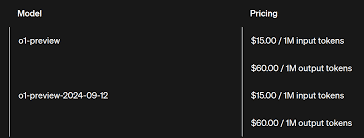
The o1-preview API is priced at $15 per 1 million input tokens and $60 per 1 million output tokens—significantly more than GPT-4o’s $5 and $15, respectively. Small businesses need to weigh these costs against the long-term ROI of enhanced accuracy and reduced manual effort.
Specialization vs. Generalization
o1’s reasoning abilities make it highly specialized for technical and logical workflows, but it falls short in general knowledge tasks when compared to broader language models or even its GPT predecessors.
The Future Potential of o1
o1 is an essential step in OpenAI’s vision of reshaping how we approach AI-powered reasoning. Its ability to handle long, complex tasks effectively means it could soon play a role in creating fully autonomous AI agents capable of making decisions on behalf of users.
For SMBs, the adoption of o1 could signal a shift toward more strategic applications of AI, where technology is central not just to menial task automation but to independent problem-solving. Fields like medicine, engineering, real estate, and research stand to benefit immensely from the model’s evolving technical capabilities.
If you’re a small- to medium-sized business looking to integrate AI reasoning tools into your workflows, now is the time to evaluate how OpenAI’s o1 model could transform your operations. Whether you need help automating complex tasks, streamlining backend processes, or enhancing technical research, o1 offers a versatile solution tailored to your needs.
For a consultation on how to implement AI effectively into your business—or to get started on building your AI strategy—reach out today. Let me help your business achieve its efficiency and productivity goals through the power of cutting-edge AI technology.
Article Sources
- Introducing OpenAI o1, 2024, OpenAI
- Powerful AI for Business, 2024, PaleoTech AI