
Powerful AI Cost Management

The Executive’s AI Control Layer
In this newsletter you can expect powerful AI Cost Management tips:
Welcome to the AI Lighthouse!
Executives are no longer asking whether to use AI. The question they’re wrestling with now is far more uncomfortable:
How do we double down on AI without locking ourselves into the wrong vendors, blowing up our budgets, or creating a governance mess we’ll regret in three years?
Most organizations don’t have an answer. They have pilots. They have proof-of-concepts. They have a growing sprawl of prompts, agents, and shadow projects scattered across teams and tools. What they don’t have is an executive-grade way to decide: “Is this AI investment actually safe, strategic, and scalable?”
That’s what this issue is about.
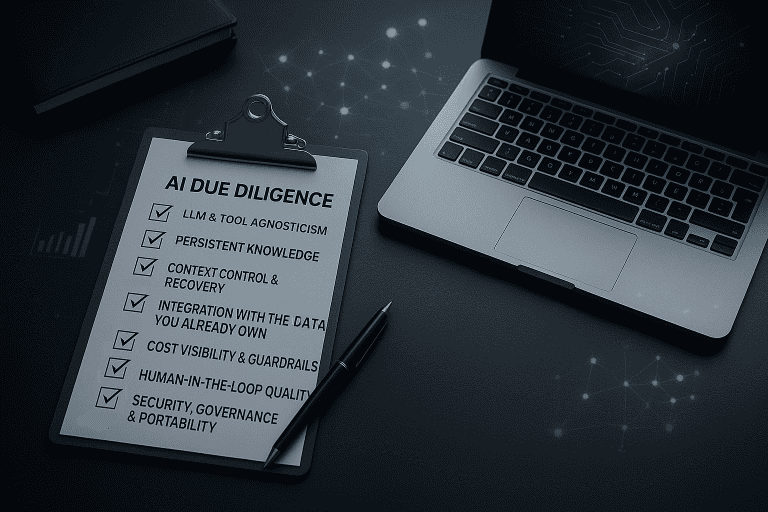
Our lead article, “The Executive’s AI Due Diligence: 7 Critical Non-Negotiables,” offers a simple lens you can take into any boardroom, steering committee, or vendor call.
Instead of chasing the latest model announcement, you can evaluate your AI stack against seven concrete dimensions: from LLM and tool agnosticism, to persistent knowledge, context control and recovery, integration with the data you already own, cost visibility and guardrails, human-in-the-loop quality, and security, governance, and portability.
Taken together, these aren’t “nice to haves.” They’re the minimum bar for an AI strategy that can survive real-world constraints: shifting models, tightening budgets, and rising regulatory pressure.
In this and our supporting articles, we’ll dig into why LLM-agnostic architectures matter, how to thrive through the AI cost crunch, and why the smartest companies are focusing less on shiny demos and more on building an AI control layer that turns everyday AI conversations into durable strategic assets.
If you’re feeling the pressure to “do more with AI” but want a framework that will still look sane in 2026, you’re in the right place.
The Paleotech AI Team
Feature Articles:
- Thriving Amid the AI Cost Crunch (Non-Negotiable #5: Cost Visibility & Guardrails)
- Why Companies Need LLM-Agnostic AI (Non-Negotiable #1: LLM & Tool Agnosticism)
- While Others Waste Billions on AI, Use the Data You Already Own (Non-Negotiable #4: Integration with the Data You Already Own)
Recent Blog Posts:
- AI Workslop Destroys $9M in Productivity (Non-Negotiable #6: Human-in-the-Loop Quality, #5: Cost Visibility & Guardrails)
- 90% of Employees Use Chat AI — Turn It Into ROI (Non-Negotiables #2: Persistent Knowledge, #6: Human-in-the-Loop Quality, #7: Security & Governance)
Follow us
Featured Articles
The Executive’s AI Due Diligence: 7 Critical Non-Negotiables

Thriving Amid The AI Cost Crunch: Strategies for Success

Why Companies Need LLM-Agnostic AI

While Others Waste Billions on AI, Use Existing Data You Already Own

Multi-Model Gateways Move Into the Mainstream
🔍Spotlight
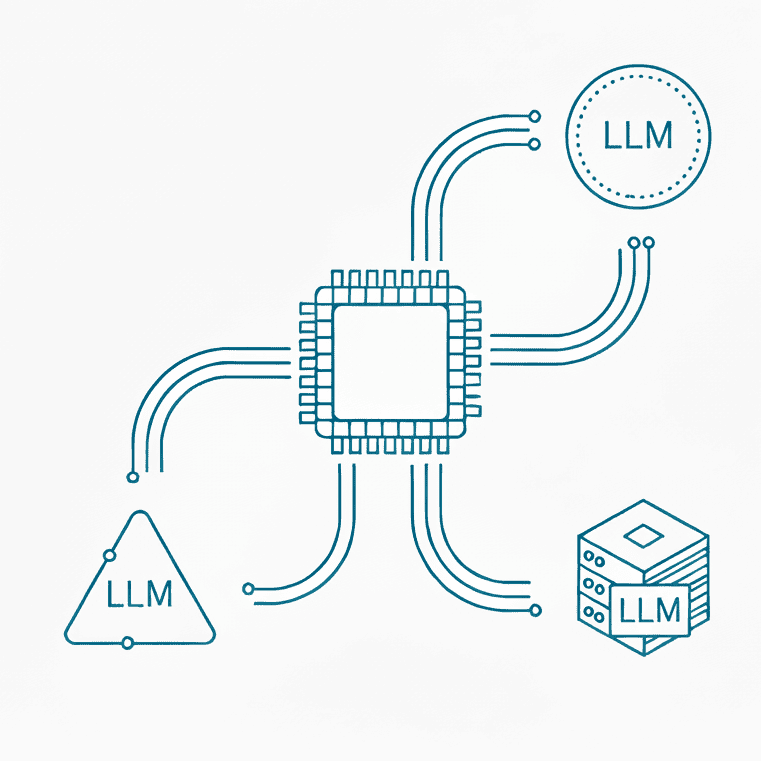
Gateway services let teams call models from providers like OpenAI, Anthropic, and Meta through a single API. The pitch is flexibility: compare or swap models without rewiring every app.
🔮Deep Dive
- One abstraction for many models reduces key sprawl and duplicated integration work.
- Teams can A/B test models for cost, latency, and quality on the same prompts.
- This space targets developers and infra teams rather than end-user chat UX.
🌅The Horizon
The ecosystem is clearly moving toward multi-model abstractions: gateways, orchestration layers, and workspaces, rather than one-vendor stacks. Architectures that assume you’ll use several models over time will age better than ones hard-wired to a single provider.
📚Read about it Here
AI Cost Management Becomes Its Own Category

🔍Spotlight
FinOps platforms and AI cost dashboards are carving out a niche: consolidated views of AI-related spend, budgets, and trends across clouds and providers, instead of burying everything in one cloud bill.
🔮Deep Dive
- A global Crayon/Sapio survey found 94% of IT leaders struggle with cloud costs, and AI is quickly becoming a top driver of that complexity.
- Vantage, for example, treats AI workloads as a distinct, visible line item in broader cloud cost dashboards.
- FinOps is emerging as the discipline that ties cloud and AI spend back to business value, not just infrastructure metrics.
🌅The Horizon
The bar is shifting from “AI probably saves time” to “show me where AI spend is going, by provider and use case.” Some organizations will solve at the infra layer; others will add analytics at the LLM and workspace layer. Either way, leaders will expect clearer, multi-provider visibility—not guesses.
AI Developments: Put the Non-Negotiables to Work
Here we provide quick “get started” ways of addressing the non-negotiables in your own business.
Turn Chat Threads into Reusable Knowledge (Persistent Knowledge)
Most teams still treat AI chats as disposable. This week, start a lightweight stopgap:
- Pick one high-value workflow (e.g., strategy briefs, code reviews, customer email drafts).
- Create a shared “AI Wins” page in Notion/Confluence/SharePoint/etc..
- Any time someone gets a great result from chat AI, they paste:
- the prompt,
- the best output,
- 1–2 tags (e.g., #market-research, #python, #sales-email).
- Add a short note: “When to use this” and “What to watch out for.”
- Review and prune once a month so it stays sharp, not bloated.
It’s a basic version of Persistent Knowledge: good enough to prove the value now (but inconvenient enough that you’ll clearly see why a dedicated system is worth having later).
Manual Context Control & Recovery (Context Control & Recovery)
Until you have tools that support true conversation forking and context editing, you can reduce “context corruption” with a simple pattern:
- Before a long AI session, write a one-paragraph brief: goal, audience, constraints.
- Paste that brief at the top of every new chat you start on the topic.
- When a thread starts to drift, copy the last “good” exchange and start a new chat with:
“Start from this point in the conversation. Ignore anything that came after.” - Keep a small doc of “canonical context” (product facts, policies, style guides) you can paste in, instead of re-typing it every time.
This is the manual version of Context Control & Recovery. It works—but it also makes it obvious how much leverage you’d gain from tools that can fork and edit context natively.
Start a Simple AI Cost & Usage Log (Cost Visibility & Guardrails)
Before you roll out dedicated cost tooling, you can at least start seeing where AI is being used and why it matters:
- Create a one-page spreadsheet with columns for date, tool/model, person, project, rough usage, and outcome.
- Ask teams to log only higher-effort or higher-stakes AI work (e.g., long research sessions, big batch content jobs).
- At month-end, skim for patterns:
- Which projects lean heaviest on AI?
- Which tools are people defaulting to?
- Where did AI clearly save time—or clearly waste it?
This won’t replace proper Cost Visibility & Guardrails, but it can surface where you most urgently need a real AI control layer, and give you concrete stories when you decide it’s time to invest in one.
Further Reading
LLM & Tool Agnosticism

Cost Visibility & Guardrails, Persistent Knowledge,
and Human-in-the-Loop Quality & Governance


Putting It All Together
If there’s one theme in this issue, it’s this: The question isn’t “Which AI tools should we buy?”
It’s “What should our AI control layer look like so tools, data, and costs stay under control?” The 7 non-negotiables give you that standard. You don’t have to memorize them—just keep coming back to a few core questions.
5 Questions to Ask Before You Approve the Next AI Initiative
- Multi-Model Flexibility: If this AI vendor, model, or tool disappeared tomorrow, how easily could we switch—without rebuilding everything?
- Knowledge Retention: Do our best AI conversations and prompts turn into reusable assets, or do they vanish into chat history?
- Context & Data: Does our AI system actually understand our context and connect to the data we already own, or are we copy-pasting forever?
- Cost & Control: Can we see where AI spend is going by team and use case—and are there real guardrails, or just good intentions?
- Quality, Governance & Safety: Who is reviewing, correcting, and improving AI output—and how will we explain our choices to regulators, customers, or the board?
If those five questions make you uneasy, that’s a signal to pause—not to move faster.
Where Paleotech Fits In
We’re spending most of our time right now helping leadership teams:
- Apply the 7 non-negotiables to their current AI portfolio.
- Design LLM-agnostic, cost-aware, data-first architectures that can survive the next wave of model changes.
- Turn everyday AI chat conversations into strategic assets, not disposable experiments.
If you’d like to:
- Pressure-test your current AI roadmap against this framework,
- Run an AI due-diligence session with your leadership team, or
- Be first in line as we roll out new ways to operationalize these principles in real workflows
Just hit reply or book a conversation with us. We’re happy to walk through where you are today and what an AI layer that’s organized, on-budget, and under your control could look like in your organization.
Thanks for reading.

| Was this email forwarded to you? Sign up for free here. Interested in using AI in your organization? Click here Unsubscribe | Update your profile | 113 Cherry St #92768, Seattle, WA 98104-2205 (c) 2025 Yottabyte Dynamics Inc. |