Part 1: Why RAG Matters in AI for Business


This is the first in a three-part series of articles I am offering to businesses to help them understand how to best leverage AI. In this first part, I’ll introduce RAG and explain why RAG matters in AI For Business. This information will also be available in video format in our online education community, launching in Q3 2025.
If you haven’t yet read my articles on AI For Business and the 2024 Guide to Taming Wild AI Hallucinations, I encourage you to check them out. They are fun and informative and provide excellent context for this next series of articles.
First things first, RAG = Retrieval Augmented Generation. It’s an emerging AI technique gaining significant traction. Put simply, it’s a way for you to customize and tailor the latest generative AI offerings to your business to gain competitive advantages. This is a game-changer for all businesses, especially those companies just starting their AI journey.
Most business owners, leaders, and AI enthusiasts have already experimented with some of the AI Chat tools offered by OpenAI (ChatGPT), Anthropic (Claude), Perplexity, and Gemini. If you haven’t yet experimented with any of these or pushed them to their limits, sign up for our newsletter, and we’ll get you going right away.
As a business owner or leader, you’ll want to understand RAG to gain a competitive edge.
RAG enhances the capabilities of Large Language Models (LLMs) by integrating your custom business data and external real-time data sources with pre-trained Large Language models. This combination is designed to provide accurate, up-to-date, and context-relevant responses. For SMBs venturing into AI automation tools, RAG can offer exceptional improvements across various domains – such as customer interactions, content generation, internal workflows, and even real-time data processing.
What is Retrieval Augmented Generation (RAG)?
First, lets look at where we are today for most AI users and enthusiasts:
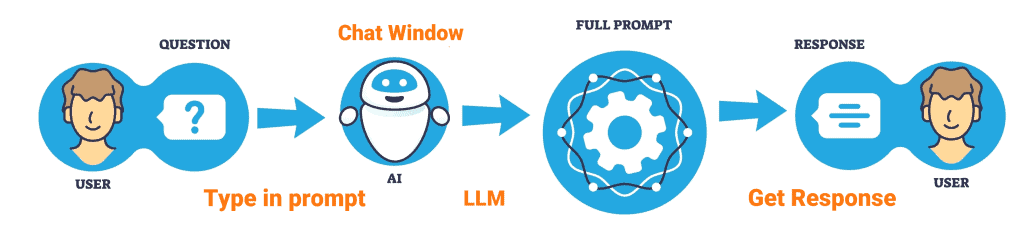
You ask it a question by typing into the chat window on your phone or browser. Then, magic happens—it responds. While this technology is truly groundbreaking, the problem with this approach is that it’s highly susceptible to serious issues like:
Hallucinations (Generating Inaccurate or Fabricated Information): LLMs often produce confident-sounding yet inaccurate or entirely fabricated responses, known as “hallucinations.” You can read my article on hallucinations here. This is a significant issue for businesses needing accurate, fact-based responses.
Limited Contextual Awareness: LLMs can struggle to understand the specific context or nuances of business operations, leading to generic or mismatched responses. RAG allows an LLM to pull from highly specific data repositories (e.g., company documents, support databases), which enriches responses with contextually relevant information, enhancing both accuracy and personalization.
Outdated Knowledge: Most LLMs retain a fixed knowledge cutoff and lack up-to-date information once trained. This static nature makes them inadequate for scenarios that rely on timely information, like recent policy updates or product changes. RAG overcomes this by fetching real-time information from databases and knowledge sources, ensuring responses remain current and applicable.
Inefficiency with Niche or Domain-Specific Knowledge: LLMs may perform poorly when asked about niche or domain-specific topics not well-covered in their training data. RAG enhances response quality by retrieving precise information from specialized databases or documents, providing LLMs with the foundational knowledge they need for more niche applications.
Privacy and Confidentiality Concerns: LLMs trained on broad, public data may inadvertently expose or misuse sensitive information. In a RAG setup, the LLM accesses proprietary knowledge bases without needing access to the raw data itself, reducing privacy risks and enabling businesses to control and customize what information is shared and used in response generation.
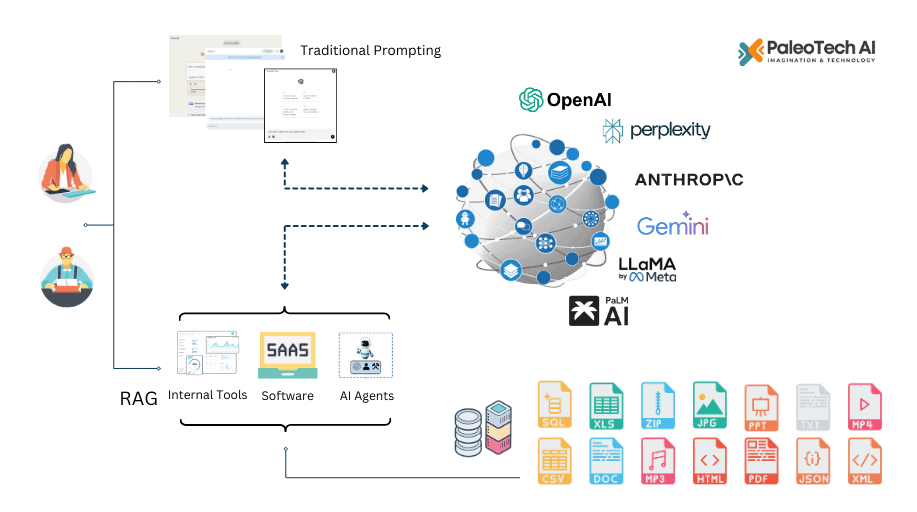
RAG mitigates all this by grounding the AI in real-time with YOUR verified data from various data sources, ensuring accuracy and relevance:

RAG introduces the concept of integrating external data into the generative process. Instead of simply relying on generic pre-trained information, RAG retrieves relevant data from your company’s internal sources, such as databases, APIs, SaaS apps, document repositories, or even the company’s own internal knowledge base. By pulling relevant insights from these sources, RAG can strengthen AI responses, enhancing relevance and factual accuracy.
Businesses can now use RAG to leverage their own data in a secure environment while still using the incredible power of these large language models from OpenAI, Anthropic, Meta, Google, Perplexity, and others.
RAG stands at the intersection of AI Automation and Natural Language Processing (NLP).
How Does RAG Work?
To understand how it works, let’s break down its main components:
Large Language Models (LLMs)
LLMs like OpenAI’s GPT or Google’s Gemini revolutionized natural language understanding and text generation. However, despite their impressive size and training on vast amounts of data, LLMs are not infallible and tend to produce hallucinated or factually incorrect responses. Their knowledge is limited to the static dataset they were trained on. This poses a challenge when high accuracy or up-to-date information is needed.Information Retrieval
The core strength of RAG lies in its ability to pull relevant information from external sources in real-time. By using a retriever mechanism, the system searches for the most contextually appropriate documents or data from a designated external source or database whenever a query is invoked.Response Generation
Once the retriever supplies relevant documents to the LLM, the model uses this curated data set to augment its generated response, ensuring it provides a more accurate and contextually relevant reply.
In other words, RAG acts as a research assistant for LLMs, retrieving supporting information before producing the final output — similar to how a student might consult textbooks while answering exam questions.
RAG combines two key phases: retrieval and generation. Here’s a simplified breakdown of how systems using RAG work:

User Query or Prompt
A user initiates the process by submitting a query to the AI system. This could be anything from a complex question to a business process-related request.Retrieval Phase
The system searches for relevant data in a specialized database, or from real-time web sources, based on the query. The retrieved data points or documents, often represented as vectors in a vector database, are ranked by their relevance to the query.Generation Phase
Once the necessary information is retrieved, the LLM processes this data and generates a response. Here, the external data augments the model’s own pre-trained knowledge. The generated response will be more accurate and nuanced due to this additional real-time information.- Fusion of Retrieved Data and LLM
The final response is a fusion of the retrieved data and the generative abilities of the LLM. The system ensures the response is fluent, coherent, and formatted in a friendly manner.
Real-World Applications of RAG
Law Firms: Enhanced Legal Research

Law firms often deal with large legal datasets, precedents, case files, and new regulations. Traditionally, massive amounts of time are spent reviewing and cross-referencing old and new legal documents. RAG has the potential to reduce the manual labor required for this task. Instead of relying solely on pre-trained LLMs, RAG can augment searches with real-time legal precedents and statutes, enabling firms to quickly complete more accurate or up-to-date research.
Healthcare: Medical AI Assistants

Healthcare organizations are streamlining administrative processes like appointment scheduling using AI, but the complexity of medical information makes RAG an attractive tool for higher-end use cases. For instance, an RAG-based AI system could retrieve real-time medical data, research articles, and patient history to provide surgeons, doctors, or medical officers with the most recent procedures, drug interactions, or treatment guidelines.
Real Estate Agents: Effective Lead Scoring

Real estate agents often juggle multiple leads while trying to prioritize who will likely convert to a sale. With RAG, agents can input diverse data sources – such as property websites, social media interactions, and recording previous buyer behavior – and retrieve relevant, real-time insights to score leads according to their likelihood of making a purchase. This process can dramatically improve follow-up strategies and reduce time spent chasing cold leads.
Content Agencies: Streamlined Campaign Creation

RAG offers enormous benefits for content creators and marketing agencies by automating the content generation process. From writing SEO-rich blog posts to developing creative social media assets, these businesses can harness real-time search data, trends, and keywords that connect deeply with relevant media channels. This frees up human resources and ensures greater consistency in large volume campaigns.
Customer Support: Smarter Chatbots

Traditional customer support chatbots may falter when faced with complex queries or need real-time answers. RAG-powered chatbots can significantly enhance the quality of customer interactions by retrieving relevant documentation, training materials, FAQs, and even customer service logs in real time. This can sharpen chatbot accuracy and provide an immediate, satisfying customer experience, all while freeing agents to handle more complex, personalized queries.
Implementing RAG for Beginners
Implementing RAG for small businesses may initially sound daunting, but many existing tools and frameworks make the process approachable.
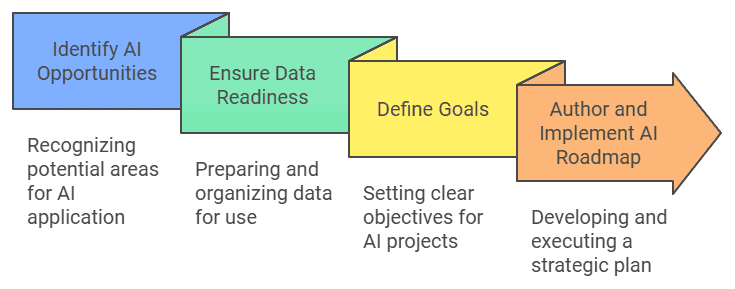
At PaleoTech AI, we’ve simplified this process, making it effortless for business leaders to get started:
- Identify all the areas of your business where AI can make significant changes
- Audit your data infrastructure and all data sources that need to be included. We evaluate the completeness, accuracy, and relevance of your data. This includes assessing if the necessary data is available and if it’s clean and labeled in a way that makes it usable for AI.
- Once we’ve performed the necessary due diligence on the available data, we further align by establishing clear, measurable goals that AI can support, making the technology’s value understandable and practical for business owners.
- Brainstorming, prioritization, and feasibility checks, along with a final high-level roadmap and well-defined success metrics, set the stage for implementation and delivery.
Challenges and Considerations in RAG Implementation
Getting started with RAG is simpler than it might sound, and the journey from basic to advanced RAG capabilities can be seamless. For most businesses, RAG begins with straightforward tools that enhance information access, like an AI-powered assistant capable of pulling accurate answers from your existing documents. Over time, as you see the benefits, you can gradually expand RAG’s role—integrating it with specific data sources, customizing its responses to fit unique customer needs, and developing industry-specific insights. This phased approach makes RAG accessible at every level of investment, allowing your business to grow its AI capabilities as your needs evolve. With flexible RAG solutions, it’s possible to start small, quickly see value, and, over time, create a powerful, customized AI that drives efficiency, customer satisfaction, and growth. For businesses looking to unlock more, we’re here to guide each step, turning curiosity into impactful results.
Complexity of Setup for Advanced RAG Implementations
Setting up RAG requires some initial infrastructure investment. Advanced RAG systems demand a functional vector database and a fine-tuned retrieval pipeline to ensure the model’s optimal performance.
Data Quality
The quality and relevance of the data being retrieved play a key role in the initiative’s success. This can not be overstated. Inaccurate or irrelevant data can degrade the AI system’s performance. Therefore, it is critical to use only high-quality data sources and ensure regular updates.
Privacy and Compliance
With many data protection regulations in place, especially in sectors like healthcare and legal, RAG implementation must take privacy and security seriously. Businesses should ensure that all data used in retrieval processes comply with HIPAA, GDPR and other data privacy standards.
Cost of Maintenance
With dynamic, real-time data retrieval, the system requires regular maintenance and tuning to ensure optimal operational efficiency. Businesses need to factor in these costs when planning their AI budget.
Future Developments in RAG
With advancements in technology, RAG is expected to become more accessible, adaptable, and intelligent in the coming years. Some trends pointing to future developments include:
- Improved Multimodal Capabilities – Expansion beyond text-based retrieval to include video, audio, and images.
- Enhanced Personalization – AI systems that adapt more accurately to specific industries or individual user inputs.
- Incorporation into Routine Workflows – Expect AI systems utilizing RAG to be increasingly embedded into everyday operations, from basic administrative tasks to complex decision-making processes.
My (3) Three-Part Educational Thought Piece on RAG
I hope you enjoyed the first part of this 3 part series on RAG! Sign up for my newsletter to be sure you are notified when Part 2 and Part 3 are released: NEWSLETTER
Part 1: Why RAG Matters for Your Business
Release Date: November 2024
In this first part, we introduced RAG – what it is and why it’s important. We also talked about how it works and provided some real-world examples. For those just getting started with AI and RAG, I offered a 4-step high-level process that a) Identifies AI opportunities, b) Ensures your data is ready, c) Defines goals, and d) Documents and implements a powerful AI Roadmap.
Part 2: Monetizing AI with RAG
Release Date: December 2024
In part 2, we’ll build on this foundation by exploring how most businesses are sitting on a goldmine of untapped knowledge – trapped in documents, conversations, and processes – that could be driving profits but instead gather digital dust. In this next piece, I’ll reveal how this technology creates immediate value by turning static information into dynamic assets. I’ll show you how to use RAG to outmaneuver larger competitors, slash operational costs, and create new revenue streams from existing resources. This installment will show you exactly how much money you’re leaving on the table by not harnessing your business’s collective knowledge.
Part 3: The 90-Day AI Blueprint: Achieve Success Quickly
Release Date: February 2025
The final installment cuts through the complexity of AI adoption to deliver a practical, time-bound framework for bringing AI into your business. Unlike traditional technology implementations that can drag on for months or years, we’ll show you how to achieve meaningful results in just 90 days. Through a step-by-step blueprint, you’ll learn how to identify your highest-impact opportunities, avoid costly mistakes, and build momentum with quick wins that fund further expansion. This actionable guide includes specific milestones, budget considerations, and ready-to-use templates that take the guesswork out of implementation. By the end of this piece, you’ll have everything needed to confidently begin your AI journey and start seeing results within one fiscal quarter.
Take the next step toward boosting your business efficiency by getting in touch with us today for a personalized consultation. Together, we can explore how RAG and other AI tools can transform your business. Let’s innovate your processes for a more profitable and productive future!
If you are a small to medium-sized business looking to leverage the power of AI automation to streamline your operations, reduce costs, and drive growth, now is the perfect time to take the next step. Here are some steps we can help you with immediately:
- Assess Your Needs: Identify the areas in your business where AI automation can make the most impact.
- Choose the Right Tools: Select AI tools that align with your business needs and goals.
- Implement and Integrate: Work with experts to implement and integrate AI tools into your existing workflows.
- Monitor and Optimize: Continuously monitor the performance of your AI tools and optimize them as needed.
For more information on how to get started with AI automation or to discuss how these tools can be tailored to your specific business needs, feel free to contact us. Together, we can harness the power of AI to transform your business operations and drive success.
Article Sources
- GitHub Hallucination Leader Board, 2024, GitHub
- Powerful AI for Business in 2025, 2025, Paleotech AI
- What is RAG (Retrieval-Augmented Generation)?, 2024, Amazon
- What Is Retrieval-Augmented Generation, aka RAG?, 2024, Nvidia
- What is Retrieval-Augmented Generation (RAG)?, 2024, Google
- What Is Retrieval Augmented Generation, or RAG?, 2024, Databricks
- The Powerful MedGraphRAG Revolution: Transforming AI Healthcare in 2024, 2024, PaleoTech AI